Practical, actionable, connects everyday land use choices by farmers, homeowners, and local governments to downstream water quality outcomes. Covers best management practices, riparian buffers, cover crops, and green infrastructure. Forward-looking rather than problem-focused.
Drafting now. Mobile-first, short paragraphs, table, bullets, no em dashes, no AI tells.
How Land Use Decisions Shape Water Quality Downstream
Every piece of land in a watershed tells water where to go.
A paved parking lot sends it rushing across the surface. A healthy cornfield with cover crops lets it soak in. A forested hillside slows it down and filters it through layers of roots and soil before it reaches a stream.
The decisions made about how land is used across an entire watershed add up to the water quality that comes out the other end. Some of those decisions happen at the farm level. Some at the neighborhood level. Some in city planning offices and county zoning boards.
All of them matter.
The Land Use and Water Quality Connection
Different land uses produce dramatically different water quality outcomes even when rainfall is identical.
| Land Use | Runoff Rate | Primary Water Quality Concern |
|---|---|---|
| Forest | 5 to 15% of rainfall | Minimal — natural filtration intact |
| Well-managed cropland | 20 to 40% of rainfall | Sediment, nutrients if practices are poor |
| Row crops with bare soil | 40 to 60% of rainfall | High sediment and nutrient loading |
| Urban residential | 30 to 50% of rainfall | Nutrients, bacteria, chemicals, heat |
| Commercial and industrial | 60 to 90% of rainfall | High runoff volume, chemical contamination risk |
The more impervious surface a watershed contains and the less vegetated cover it has the more runoff it generates and the more contamination that runoff carries.
Agricultural Land Use
Agriculture covers roughly half of the land area in the contiguous United States. How that land is managed has an outsized effect on water quality across the country.
The practices that do the most damage are also the most common in conventional production systems:
- Leaving soil bare between growing seasons, exposing it to erosion
- Applying fertilizer at rates higher than crops can absorb
- Tiling wetlands to drain fields faster
- Removing vegetated buffers along streams to maximize cropped acres
The practices that protect water quality are increasingly well understood and in many cases economically beneficial:
- Cover crops planted after harvest hold soil and absorb excess nutrients
- Reduced tillage or no-till farming maintains soil structure and reduces erosion
- Precision nutrient application reduces fertilizer losses to waterways
- Restoring or maintaining buffer strips along streams filters runoff before it enters waterways
Buffer strips are one of the most cost-effective water quality tools available. A 50-foot vegetated buffer along a stream can remove up to 85 percent of the sediment and 50 percent of the nutrients in runoff before they reach the water.
Urban and Suburban Land Use
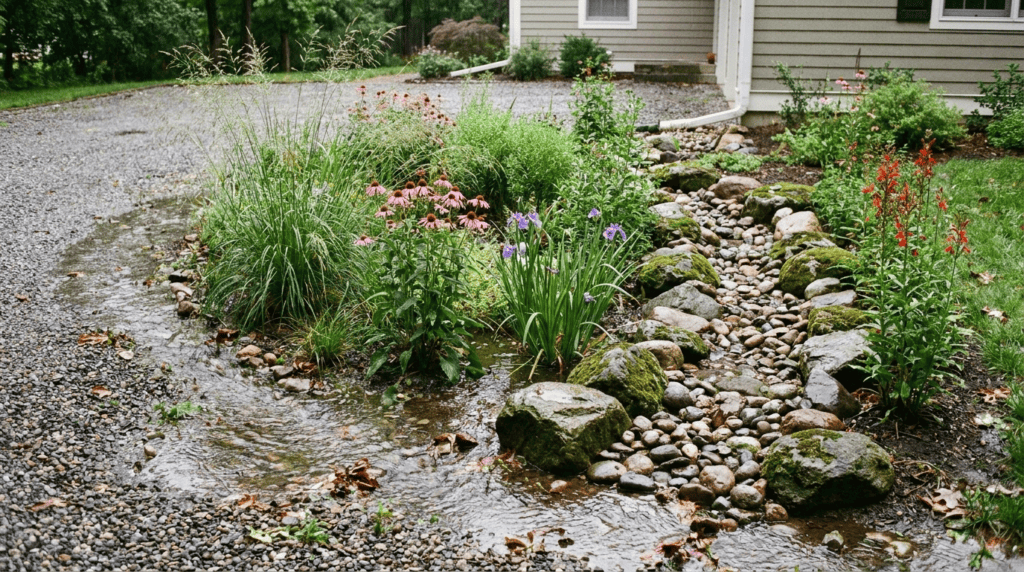
Developed areas present different but equally significant water quality challenges.
Impervious surfaces prevent infiltration and concentrate runoff. Storm drains collect that runoff and discharge it directly to waterways without treatment. Lawns treated with fertilizers and pesticides contribute nutrient and chemical loading. Failing septic systems in older subdivisions add bacteria and nutrients to groundwater.
Green infrastructure approaches address these issues by restoring some of the natural water cycle functions that development eliminates:
- Rain gardens capture and infiltrate stormwater runoff from rooftops and driveways
- Bioswales filter runoff as it moves through vegetated channels
- Permeable pavement allows water to infiltrate rather than run off
- Green roofs absorb rainfall and reduce runoff volume
- Urban tree canopy intercepts rainfall and reduces runoff while providing shade that moderates water temperatures
These approaches work at the individual property level and at the neighborhood and municipal scale.
What Homeowners Can Do
Individual land use decisions add up across a watershed.
A few practices that make a real difference:
- Reduce lawn fertilizer applications and never apply before rain is forecast
- Direct downspouts toward vegetated areas rather than paved surfaces
- Maintain a native plant buffer between lawn and any nearby stream, pond, or wetland
- Use a rain barrel or rain garden to capture roof runoff
- Pick up pet waste, which carries bacteria and nutrients into stormwater
- Avoid using pesticides and herbicides near waterways
None of these require major investments. Collectively across a neighborhood or watershed they produce measurable improvements in water quality.
The Role of Land Use Planning
Local zoning and land use planning shape water quality outcomes for decades.
Decisions about where development is permitted, what stormwater standards new construction must meet, how much impervious surface is allowed, and whether natural areas and wetlands are protected determine the long-term trajectory of water quality in a watershed.
Communities that integrate watershed protection into land use planning tend to have better water quality outcomes and lower infrastructure costs over time. Protecting a wetland through zoning costs nothing. Replacing the flood control and water quality services that wetland provided once it is filled costs millions.
The most effective land use planning treats the watershed as the relevant unit of management rather than the political boundary. What is permitted at the edge of one jurisdiction affects water quality in the next one downstream.
Leave a Reply